




Introduction
The leading causes of death worldwide and in Türkiye include
cardiovascular diseases, cancers, respiratory diseases, and diabetes—conditions
closely related to nutrition and metabolism. One common risk factor among these
diseases is obesity. Numerous
studies indicate that changes in diet and lifestyle can improve human health.
Alongside nutrition and physical activity goals, various weight loss products
marketed as "slimming products" have emerged as modern solutions for
weight management.
These plant-based products are particularly favored by women,
creating a growing market demand. Today, herbal teas, coffees, and smoothies
marketed with claims such as "fat-burning" and
"edema-reducing/diuretic" have become widely accessible with just a
click. However, are these products, often purchased based on recommendations
from friends, relatives, or online sources, truly beneficial? Before discussing
these claims, it is essential to define edema.
What is edema?
As is well known, about 60-70% of our body is composed of water. Most of this water is found inside our cells, while a portion exists outside the cells. When the fluid balance between these compartments is disrupted, excess fluid accumulation can lead to swelling in tissues or organs, a condition known as edema. Depending on its cause, edema can occur in the hands, face, arms, legs, feet, and ankles. The affected skin often appears tight and shiny.
What are the main causes of edema?
- Dietary factors: Inadequate protein and calorie intake, insufficient water consumption,
excessive salt intake, and high alcohol/tea/coffee consumption
- Sedentary lifestyle, prolonged sitting or inactivity
- Hormonal changes: PMS (premenstrual syndrome), pregnancy, and menopause
- Chronic health conditions: Heart failure, nephrotic syndrome, cirrhosis, and other major
kidney, liver, and heart diseases
- Circulatory and lymphatic issues: Conditions such as cellulitis
and lymphedema
- Medications: Some blood pressure medications, antidepressants, antivirals,
chemotherapy drugs, hormone medications, certain diabetes medications,
NSAIDs (e.g., aspirin)
- Allergic reactions: Urticaria, angioedema
As seen, edema has multiple causes. So, what exactly
are diuretic drinks?
What are diuretic drinks?
Diuretic drinks are beverages made from plants,
vegetables, and fruits believed to help eliminate
excess water from the body. The diuretic
(water-removing) effect of these plant-base drinks is primarily due to phytochemicals, which are active
compounds responsible for their unique color,
aroma, and taste. Examples include alkaloids, flavonoids, saponins, triterpenoids, glycosides, and nitrates.
These drinks help reduce water retention in two main ways:
- Increasing blood flow, leading to blood vessel dilation.
- Preventing the reabsorption of excess water and minerals (such as sodium, chloride, and
potassium), facilitating their removal from the body.
To better understand diuretic drinks, they can be
categorized into two main groups:
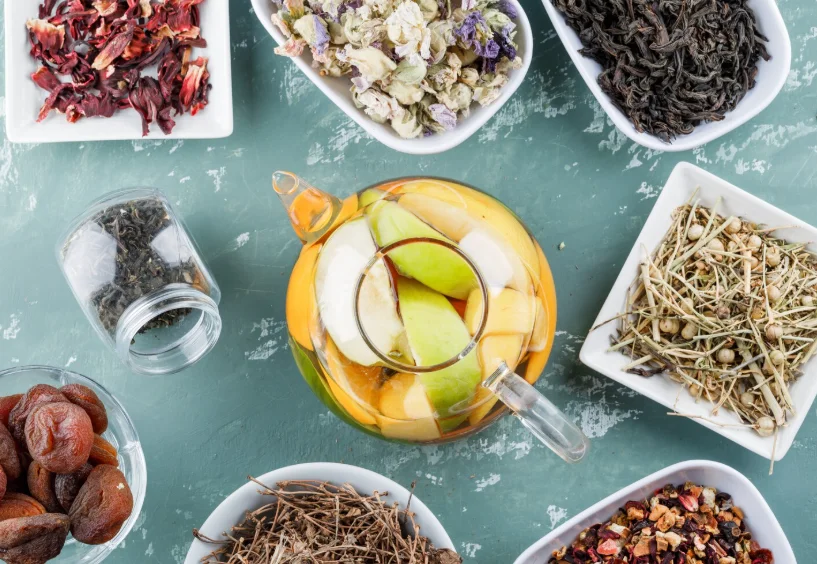
- Diuretic teas and coffees
- Fruit and vegetable-based juices
Diuretic teas and coffees
After water, hot tea and coffee are among the most consumed beverages worldwide.
These drinks contain active compounds such as caffeine, catechins, flavonols, and diterpenes, which may aid weight control and obesity management.
The most common herbs found in teas and
coffees marketed as "diuretic," "weight loss aid," or
"fat-burning" include:
- Green Tea: May
support weight management by increasing fat burning. Its caffeine content
also provides a diuretic
effect.
- Cherry Stalk: High in potassium and
flavonoids, offering a mild
diuretic effect. Used in traditional
Persian medicine for kidney stones.
- Heather Leaves: Rich in flavonoids,
helps remove excess water, relieves constipation, and has antimicrobial
properties.
- Rosemary: May support
weight loss, regulates blood sugar, and lowers cholesterol.
- Yerba Mate: Contains caffeine,
providing an energizing and
diuretic effect. It may also relax blood vessels and support weight
loss.
- Peppermint: Aids digestion and helps relieve bloating, nausea, and vomiting.
- Dandelion: Known
for its diuretic properties,
may help reduce bloating.
- Hibiscus: Rich in
vitamin C, potassium, and
antioxidants, may help lower blood pressure and cholesterol.
- Cinnamon: Known for its many health
benefits. It reduces inflammation in the body, balances blood sugar,
fights microbes, may help reduce cancer risk, and lowers cholesterol. Due
to its diuretic effect, it may also be used as a diuretic.
- Turmeric:
Contains curcumin, which reduces inflammation, supports digestion, regulates blood sugar, and helps prevent
weight gain.
Fruit and vegetable-based juices
Fruits and
vegetables, with their content rich in vitamins, minerals, and water, are
preferred for supporting immunity and eliminating toxins and edema. For
example, 100% fruit juices are rich in vitamins A, C, E, K, and B group
vitamins, minerals like potassium, iron, manganese, fiber, and many active
compounds. Therefore, fruit/vegetable juices, thanks to these components in
their content, may provide protection against cancer, diabetes, cardiovascular,
and nervous system diseases (such as Alzheimer’s and Parkinson’s diseases). In
recent years, these juices, which are also sold in the form of smoothies with
different combinations or prepared at home, feature the following main
fruits/vegetables:
- Cucumber: High in potassium and water, helps
remove excess fluids, reduce inflammation, and fight infections. Known for
its antioxidant and analgesic properties, it may also relieve constipation.
- Spinach: Rich in nitrates and
potassium, promotes blood
circulation and eliminates excess fluids. It may also lower the
risk of diabetes, cardiovascular diseases and cancer.
- Beetroot: It may lower blood pressure by
dilating blood vessels with its nitrate compounds. Also, facilitates the
delivery of oxygen to tissues and has positive effects on sports
performance. It is rich in minerals such as potassium, magnesium, calcium,
phosphorus, and iron.
- Watermelon: Contains over
90% water and is rich in potassium. With these properties, it may increase
urine production without straining the kidneys. Additionally, it may lower
blood pressure while protecting heart health.
- Lemon: With its beneficial compounds,
it may improve metabolism, prevent insulin resistance, and facilitate
weight loss with a proper nutrition plan. In addition to its diuretic
effect for toxin elimination, it may also prevent the formation of kidney
stones and gallstones with the citric
acid it contains.
- Parsley: Removes
excess water and sodium
while preserving potassium.
- Celery: 95% water content, may help lower blood pressure and acts as
a diuretic.
- Pineapple: Contains various vitamins and
minerals, has bromelain, an enzyme that breaks down proteins. Due to these
properties, it is used as a digestive aid and a diuretic.
- Red/Purple Berries: Berries such as strawberries, blackberries, raspberries,
blueberries, and cranberries are rich in anthocyanins, a color pigment,
vitamin C, water, and fiber. They have protective effects against type 2
diabetes, cardiovascular diseases, cancer, and nervous system disorders.
Can diuretic drinks really be effective?
The main effects of these drinks consumed for the purpose of
reducing edema can be summarized in four points:
- Diuretic Effect: The caffeine, flavonoids, polyphenols, and potassium in these drinks
may increase urine production.
- Vasodilation: Some active compounds may relax blood vessels, improving circulation
and fluid balance.
- Anti-Inflammatory Effects: Edema can sometimes be caused by inflammation-based
diseases (such as type 2 diabetes, metabolic disorders, cardiovascular
diseases, kidney problems, rheumatoid arthritis, etc.). Foods with high
antioxidant content, such as ginger, cinnamon, and red-purple fruits, may
help reduce inflammation and assist in the elimination of edema.
- Sodium-Potassium Balance: Potassium-rich fruits and vegetables help remove excess sodium and
water.
Aside from
these, the effects of these drinks on weight loss are not miraculous and are
minimal when consumed alone. Therefore, for healthy weight loss, these drinks
can be occasionally included in the routine under the supervision of a
healthcare professional (doctor, dietitian, pharmacist), in addition to a
personalized proper nutrition plan and regular physical activity.
Common Misconceptions About Diuretic Drinks
• “They provide rapid and permanent weight loss.”
The fast weight loss associated with diuretic drinks is mostly due to water
loss in the body and is not permanent. For more effective and sustainable
weight loss, a personalized and proper nutrition plan combined with physical
activity is essential.
• “Since they contain natural ingredients, anyone can consume them.”
Human studies on these drinks, which are marketed with various health claims,
are limited, and their mechanisms of action are not fully understood.
Therefore, their use may be unsafe for pregnant and breastfeeding women.
Individuals with chronic conditions such as cardiovascular or kidney diseases
who require regular medication should consult a healthcare professional before
consuming such products. Since diuretic drinks contain components with
“water-removing” effects, they may interact with blood pressure medications,
diuretics, and blood thinners. This interaction may negatively affect medical treatment
and lead to various side effects.
• “Since they are natural, they can be consumed in any amount and
for an unlimited period.”
The fact that a product is entirely natural does not make it completely safe.
One of the unresolved issues regarding such herbal drinks is the appropriate
dosage and duration of use. In most cases, the amount of active compounds
obtained from plants, fruits, or vegetables through diet is insufficient to
observe their beneficial effects. As a result, people may consume these
products excessively, believing in their natural content to achieve faster and
more effective results. Frequent and high consumption may lead to allergic
reactions such as skin redness, itching, and swelling, as well as mild side
effects like nausea, vomiting, diarrhea, dizziness, and palpitations. In severe
cases, it may cause liver and kidney damage.
• “They are free from chemicals, so they have a clean content.”
Just like in any other food category, food fraud is also encountered in herbal
teas, coffee, and plant-based products. Recent inspections conducted by Turkish
Ministry of Agriculture and Forestry have revealed the presence of
pharmaceutical active ingredients, particularly in herbal teas and certain
fruit juices. One such substance, sibutramine, was initially recommended for
obesity treatment but was later banned by Turkish Ministry of Health due to its
serious cardiovascular side effects, such as heart attack and stroke. Another
critical issue is where these herbal products are purchased from. Many of these
products are bought based on recommendations from acquaintances, herbalists,
unregulated sales channels, or online platforms, where their supply conditions
remain unknown. Poorly managed supply chains may lead to contamination with
insects, parasites, fungi, pesticides, and heavy metal residues, potentially
making the product more harmful than beneficial.
Summary
Edema occurs as a result of the
disruption of the fluid balance between our cells. The causes of edema include
inadequate nutrition, inactivity, hormonal changes, certain diseases, or
medication use. The phytochemicals and minerals found in teas, coffees, fruit,
and vegetable juices, which are thought to help eliminate excess water from the
body and aid in weight loss, may play a supportive role against edema by
increasing urine output, expanding blood vessels, and reducing inflammation.
However, this effect is usually temporary, and the weight loss caused by the
elimination of edema is not permanent. For more effective treatment, it is
necessary to understand the underlying cause of the edema and act accordingly.
For healthy weight loss, balanced nutrition and physical activity are the gold
standard. Additionally, even though diuretic fluids are entirely natural, it
does not mean they are safe for everyone, and excessive consumption may lead to
side effects and interact with certain medications. Therefore, before
purchasing such drinks, it is important to consult a healthcare professional
and obtain them from reliable sources.
REFERENCES
Ahmad, A., Iqbal, T., & Altaf, S. Overview
of Plants Used in Weight Loss Remedies (2023). https://biologicaltimes.com/wp-content/uploads/journal/published_paper/volume-2/issue-11/BT_2023_800797.pdf
Akca, E., Karaalp, C., & Kaner, G.
Kadınlarda zayıflama amacıyla bitkisel ürün kullanım sıklığının ve bitkisel
ürün kullanımını etkileyen faktörlerin belirlenmesi. Türk Hijyen ve Deneysel Biyoloji Dergisi
(2019). https://jag.journalagent.com/turkhijyen/pdfs/THDBD_77_2_167_178.pdf
Akhtar, P., Ahmad, I., Jameela, A., Ashfaque,
M., & Begum, Z. Energizing Effectiveness of Cucumber (Khayarain) For
Health. A Review Article. Journal
of Emerging Technologies and Innovative Research (2020). https://odontoanamaria.com/artigos/pepino4.pdf
Akyol, E., & Danisman, M. Evaluating the
efficacy of cherry stem extracts against calcium oxalate monohydrate
crystallization in kidney stone treatment. Bulgarian Chemical Communications (2024). http://www.bcc.bas.bg/bcc_volumes/Volume_56_Number_3_2024/BCC-56-3-2024.pdf#page=84
Alam, F., Nag, M., Islam, M. M., & Biswas,
M. S. Bromelain: A Potential Neutraceutical (2024) https://www.researchgate.net/profile/Souvik-Biswas-16/publication/383360685_Bromelain_A_Potential_Neutraceutical/links/66c9bd7fc2eaa50023136316/Bromelain-A-Potential-Neutraceutical.pdf
Alobaidi, S. Renal health benefits and
therapeutic effects of parsley (Petroselinum crispum): a review. Frontiers in Medicine (2024). https://www.frontiersin.org/journals/medicine/articles/10.3389/fmed.2024.1494740/full
Alobaidi, S., & Saleh, E. Antihypertensive
Property of Celery: A Narrative Review on Current Knowledge. International journal of food science
(2024). https://onlinelibrary.wiley.com/doi/full/10.1155/2024/9792556
Aswini, E. V., Vivek, D., & Swathilakshmi,
S. Role of phytochemicals in diuresis management. World J. Pharm. Res (2020).
https://wjpr.s3.ap-south-1.amazonaws.com/article_issue/1602926860.pdf
Bakır, B., & Şahin, G. A. Polifenollerden
Zengin Besinler ve Hipertansiyon. Turkiye
Klinikleri J Health Sci (2020).
https://d1wqtxts1xzle7.cloudfront.net/89754192/pdf-libre.pdf?1660650265=&response-content-disposition=inline%3B+filename%3DFoods_Rich_in_Polyphenols_and_Hypertensi.pdf&Expires=1739540847&Signature=T~YyBcx-KwAZgn0PhvHwyAC04yHSk-65C1b5CWLLW7hTNJpwwV2t2WUvembpbBzBpBPeuztiuStUJIXZA1vl7vjQ3KXao0XzHFGq57DBSQvVdKS4vSfrpTvmYSuKD5AUhgFKautwNjq0u26UKgRlLMcVwxTyv5QA4B2-hdpXUN88vANZolMZtulFG-BTDrS6Qk~iPmthcLwfN6m~cblFsCt3~3jr88FE67QkdCnVqfOCMRCmAWlJNs-XRvcSu0GokSODPE5ySZnjCYjPUxzskAAfAurZ0ETgBGytg4Suf0ruG3EebDaB4LJ6oXvynx4LahXVmuN0~llIMQgXR-dYIQ__&Key-Pair-Id=APKAJLOHF5GGSLRBV4ZA
Bellikci-Koyu, E., Şarer Yürekli, B. P.,
Seçkiner, S., Özdemir, N., & Büyüktuncer, Z. Use of herbal products for
weight loss in Turkey. Progr Nutr
(2020). https://www.researchgate.net/profile/Ezgi-Bellikci-Koyu/publication/344470466_Use_of_herbal_products_for_weight_loss_in_Turkey/links/5f7ad812a6fdcc008657379e/Use-of-herbal-products-for-weight-loss-in-Turkey.pdf
Eliseeva, T. Lemon water: scientific data on
benefits and contraindications. Journal
of Healthy Nutrition and Dietetics (2021). https://cyberleninka.ru/article/n/lemon-water-scientific-data-on-benefits-and-contraindications/viewer
Gamboa-Gómez, C. I., Rocha-Guzmán, N. E.,
Gallegos-Infante, J. A., Moreno-Jiménez, M. R., Vázquez-Cabral, B. D., &
González-Laredo, R. F. Plants with potential use on obesity and its
complications. EXCLI journal (2015). https://pmc.ncbi.nlm.nih.gov/articles/PMC4746997/
Golovinskaia, O., & Wang, C. K. Review of
functional and pharmacological activities of berries. Molecules (2021).
https://www.mdpi.com/1420-3049/26/13/3904
Gökçe, Z. FİTOSTEROLLER VE OBEZİTE ÜZERİNE
ETKİLERİ. 2. Ulusal Yaşam
ve Obezitede Farkındalık Kongresi
(2023). https://toros.edu.tr/storage/files/249/2.%20ULUSAL%20SA%C4%9ELIKLI%20YA%C5%9EAM%20VE%20OBEZ%C4%B0TE%20FARKINDALIK%20KONGRES%C4%B0%20B%C4%B0LD%C4%B0R%C4%B0%20K%C4%B0TABI.pdf#page=59
Hariri, M., & Ghiasvand, R. Cinnamon and
chronic diseases. Drug discovery
from mother nature (2016).
https://link.springer.com/chapter/10.1007/978-3-319-41342-6_1
Hosen, M. S., & Madhu, B. Health Benefits
of Herbal Tea: A Review (2023). https://www.researchgate.net/profile/Mohammad-Hosen-9/publication/371599733_Health_Benefits_of_Herbal_Tea_A_Review/links/648b7fc695bbbe0c6ecb485e/Health-Benefits-of-Herbal-Tea-A-Review.pdf
Sağlığı
Tehlikeye Düşürecek Gıdalar, Türkiye Tarım ve Orman Bakanlığı (2025) https://guvenilirgida.tarimorman.gov.tr/GuvenilirGida/gkd/SagligiTehlikeyeDusurecek?siteYayinDurumu=True
Swollen
ankles, feet and legs (oedema), İngiltere Ulusal Sağlık Servisi (2025) https://www.nhs.uk/conditions/oedema/
Swollen
arms and hands (oedema), İngiltere Ulusal Sağlık Servisi (2025) https://www.nhs.uk/conditions/swollen-arms-and-hands-oedema/
Kakroo, M. A., Vaitkevicius, P. V., &
Baliga, R. R. Edema. Practical
Cardiology: Evaluation and Treatment of Common Cardiovascular Disorders
(2020). https://link.springer.com/chapter/10.1007/978-3-030-28328-5_4
Lent-Schochet, D., & Jialal, I. Physiology,
edema (2019). https://europepmc.org/article/MED/30725750/NBK430685#free-full-text
Maiztegui, B., Villagarcía, H. G., Román, C.
L., Flores, L. E., Prieto, J. M., Castro, M. C., Massa, M. L., Schinella, G.
R., & Francini, F. Dietary Supplementation with Yerba Mate (Ilex paraguariensis) Infusion
Increases IRS-1 and PI3K mRNA Levels and Enhances Insulin Sensitivity and
Secretion in Rat Pancreatic Islets. Plants
(Basel, Switzerland) (2023). https://www.mdpi.com/2223-7747/12/14/2620
Nayik, G. A., & Gull, A. (Eds.). Antioxidants in fruits: properties and
health benefits Berlin/Heidelberg, Germany: Springer (2020). https://link.springer.com/content/pdf/10.1007/978-981-15-7285-2.pdf
Nazemiyeh, H., Bahadori, F., Delazar, A., Ay,
M., Topçu, G., Nahar, L., ... & Sarker, S. D. Antioxidant phenolic
compounds from the leaves of Erica arborea (Ericaceae). Natural Product Research (2008).
https://www.tandfonline.com/doi/abs/10.1080/14786410701824007
Poswal, F. S., Russell, G., Mackonochie, M.,
MacLennan, E., Adukwu, E. C., & Rolfe, V. Herbal Teas and their Health
Benefits: A Scoping Review. Plant
foods for human nutrition (Dordrecht, Netherlands) (2019). https://link.springer.com/article/10.1007/s11130-019-00750-w
Sağlık
Bakanlığı. Türkiye Bulaşıcı Olmayan Hastalıklar ve Risk Faktörleri Kohort
Çalışması (2021).
https://hsgm.saglik.gov.tr/depo/birimler/kronik-hastaliklar-ve-yasli-sagligi-db/Dokumanlar/Raporlar/v9s_NCDkohort_.pdf
Sırıken, F., Sırıken, B., & Demirci, B. Bir
Derleme: Gıda Sahtekarlığı. Gazi
Sağlık Bilimleri Dergisi (2021). https://dergipark.org.tr/tr/pub/gsbdergi/issue/60701/849513
Sukanya,
V., Neetha Dalvi, S., & DN, R. Health Benefits of Beetroot Juice. A Review. Saudi J Nurs Health Care
(2023). https://saudijournals.com/media/articles/SJNHC_68_249-251.pdf
Tewani, R., Sharma, J. K., & Rao, S. V.
Spinach (Palak) natural laxative. International
journal of applied research and technology (2016). https://arastirmax.com/en/publication/international-journal-applied-research-and-technology/1/2/140-148-spinach-palak-natural-laxative/arid/4c2d8812-32b3-4dc9-b625-89b0e72872d1
Yeniçağ, R., & Rakıcıoğlu, N. Assessing the
antioxidant potential of soft beverages in the Turkish market: a comprehensive
study. International Journal of
Food Properties (2024). https://www.tandfonline.com/doi/full/10.1080/10942912.2024.2322160#abstract